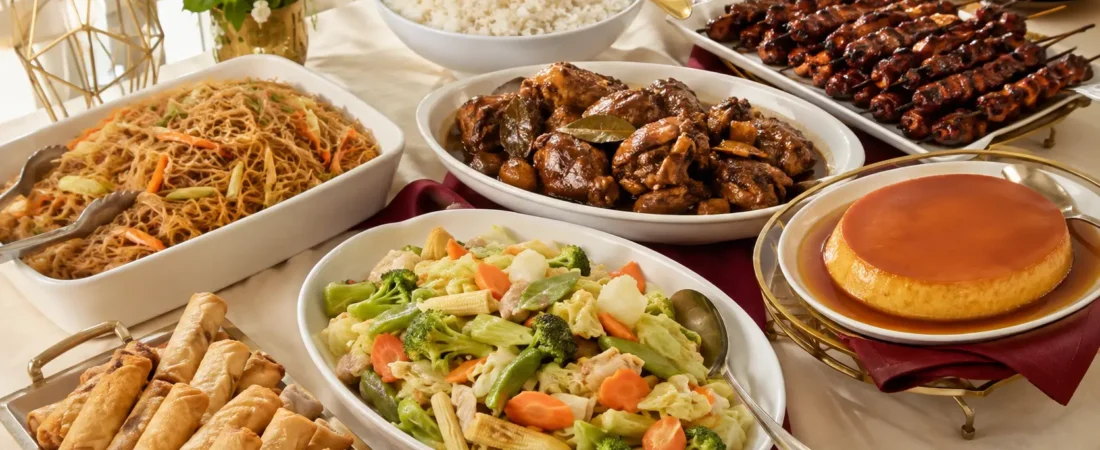
The best Filipino dishes for a party buffet are the ones that work together. A practical starting menu is steamed rice, pancit, chicken adobo, a grilled main, a vegetable dish and a Filipino dessert. Add lumpia if you want a separate appetizer or another texture on the table.
That combination gives guests several ways to build a plate without making every dish rich, fried or heavily sauced. You can then adjust the menu around family favourites, dietary requirements and the kind of celebration you are planning.
For a birthday, workplace lunch or family gathering in London, Ontario, begin with the roles your dishes need to fill. A longer menu is not automatically a better one.
Here, a balanced menu means variety in flavour, texture and choice. The examples below are planning suggestions, not fixed packages or nutritional meal plans.
If your family is combining catered dishes with a homemade holiday meal, this Thanksgiving catering plan helps identify what the table still needs.
London Filipino Catering is a quote-request and referral website. Actual dishes, ingredients, quantities and catering arrangements must be confirmed with the selected independent provider.
A simple starting menu for a Filipino buffet
For a full lunch or dinner, start with one rice dish, one noodle dish, two contrasting mains, one vegetable dish and one dessert. Treat an appetizer as an optional addition. This is a flexible planning framework, not a required number of dishes.
| Menu role | Starting choice | Possible alternative |
|---|---|---|
| Rice | Steamed rice | Garlic rice |
| Noodles | Pancit bihon | Pancit canton or Filipino-style spaghetti |
| First main | Chicken adobo | Chicken inasal |
| Second main | Pork barbecue | Beef caldereta or a confirmed plant-based main |
| Vegetables | Chop suey | Pinakbet or another available vegetable dish |
| Dessert | Leche flan | Cassava cake or biko |
| Optional appetizer | Lumpiang Shanghai | Vegetable lumpia, with ingredients confirmed |
For a smaller gathering, one main may be enough if the rest of the meal suits your guests. For a larger celebration, add dishes to answer a specific need, such as another protein choice, rather than simply filling more trays.
Explore the Filipino food options page to prepare a shortlist before requesting a menu.
Choosing Filipino dishes for a party buffet by role
Lumpiang Shanghai: a crisp appetizer
Lumpiang Shanghai adds a crisp bite alongside rice, noodles and saucy mains. It can work as an appetizer before the meal or as part of the main buffet.
Decide which role it will play before ordering. If guests will eat lumpia while waiting for dinner, include that in the quantity discussion. The same tray should not be counted twice in your plan.
Ask about the filling, piece size and dipping sauce. Providers may offer different meat or vegetable versions. If you are already choosing several fried dishes, consider whether lumpia adds something your menu still needs.
Pancit bihon or canton: choose the noodle dish deliberately
Pancit gives guests a noodle option alongside the rice. Bihon commonly uses thin rice noodles; canton uses wheat noodles. Ingredients and combinations vary: for example, Casa Manila’s menu distinguishes chicken-and-shrimp versions from specifically prepared vegan versions.
Choose one style initially. Add a second only when it serves a clear preference. Pancit, spaghetti, rice and another pasta dish can make a menu feel repetitive if there are few vegetables or mains to go with them.
Filipino-style spaghetti can be a requested substitute when your guests prefer it. Ask about the sauce, meat ingredients and toppings rather than assuming every version is the same.
Steamed rice or garlic rice: the foundation of the plate
Steamed rice is a useful starting choice when your mains already bring plenty of seasoning and sauce. Garlic rice can be an enjoyable pairing for grilled dishes when you want another layer of flavour.
Choose between them by looking at the whole plate. If you have adobo, caldereta and pancit, plain rice may provide enough contrast without adding another strongly seasoned item.
Having both rice and noodles does not mean every guest needs a full standalone serving of each. Ask the provider to plan their quantities as parts of the same meal.
Chicken adobo: a savoury main to build around
Chicken adobo is a useful option for the main dish slot. A familiar version combines chicken with vinegar, soy sauce, garlic and seasonings; other versions differ. Panlasang Pinoy’s chicken adobo recipe illustrates both the basic flavour profile and the existence of variations.
For menu contrast, consider pairing adobo with a grilled dish instead of choosing two very similar stews. Rice and a vegetable side can complete that plate.
Confirm the cut of chicken, whether bones are included, and whether the provider’s serving estimate counts pieces or meal portions. Those details affect how guests serve themselves.
Chicken inasal or Filipino barbecue: a grilled option
A grilled main can give the buffet a different texture from a saucy dish. Chicken inasal, chicken barbecue or pork barbecue are options to ask about, depending on the provider’s menu.
If you already have chicken adobo, pork barbecue offers a different protein. If your group does not eat pork, discuss chicken or a suitable alternative before finalizing the menu.
Ask about bone-in versus boneless pieces, skewer size and sauce. A skewer is a serving format, not a standardized portion. Consider whether guests will be seated or trying to eat while standing.
Beef caldereta or kare-kare: choose a distinct second main
Beef caldereta brings a tomato-based stew option. Ingredients and heat levels vary; Panlasang Pinoy’s caldereta recipe is one example of that style. Ask the provider how their version is prepared.
Kare-kare offers a different direction, often with peanut sauce. For instance, Casa Manila lists peanut-based kare-kare variations, including a vegetable version. Confirm the actual ingredients and accompaniments before selecting it.
Choose the one that adds most to the rest of your menu. You do not need both simply because they are available. A grilled main alongside either one can give guests a more varied plate.
Chop suey or pinakbet: give vegetables a real place
A vegetable dish should be part of the menu decision from the beginning. It gives guests another choice alongside meat, rice and noodles.
Chop suey or pinakbet may be available, but a vegetable category does not necessarily mean vegetarian. Remely’s vegetable menu, for example, also includes items described with pork, shrimp or oyster sauce.
Ask what goes into the specific dish, including stock, sauces and garnishes. If you need a vegetarian or vegan option, request it explicitly instead of relying on the dish’s name.
A tofu or other plant-based main: make the alternative a meal
If guests need a plant-based meal, plan a main they can enjoy with suitable rice, noodles and vegetables. A small side dish alone may not give them an equivalent choice.
Ask whether tofu adobo, vegetable afritada or another appropriate dish is available. Casa Manila’s tray shop provides examples of specifically labelled vegan dishes, but that does not establish availability or ingredients with another provider.
Confirm the complete meal, including sauces and dessert. A plant-based label is not an allergy guarantee.
Leche flan, cassava cake or biko: finish with a clear choice
Choose one main dessert, then add another only if your guests or occasion call for it. Leche flan offers a caramel custard option; Panlasang Pinoy’s recipe uses egg yolks and milk ingredients. Cassava cake or biko can offer a different dessert format.
Ask how the dessert will arrive and be served: whole, sliced, in a tray or individually portioned. That affects the utensils, plates and serving space you need.
If a birthday cake is already planned, tell the provider. Cake and a small Filipino dessert selection may be enough without adding several more sweets.
Three sample Filipino buffet menus
These are suggested combinations to discuss with a provider. They are not offers, standard tray counts or promises that every dish is available.
Menu 1: a familiar family buffet
- Steamed rice
- Pancit bihon
- Chicken adobo
- Pork barbecue
- Chop suey
- Leche flan
This combination includes a saucy main and a grilled main. Add lumpiang Shanghai if you want an appetizer; keep its quantity separate from the main-meal discussion. Ask for a different second main if pork does not suit your group.
Menu 2: a celebration menu with beef
- Steamed rice
- Pancit canton
- Chicken inasal
- Beef caldereta
- A vegetable dish chosen with the provider
- Cassava cake
The grilled chicken and beef stew give the menu two different main-dish styles. Confirm the caldereta’s heat level and the chicken’s serving format. If the event includes a separate cake, consider whether both desserts are needed.
Menu 3: a plant-based menu to confirm in advance
- Steamed rice prepared without animal ingredients
- Vegan pancit prepared with suitable noodles, stock and sauces
- Tofu adobo
- Vegetable afritada prepared without animal ingredients
- A confirmed vegan vegetable side
- A confirmed vegan dessert, or fruit prepared to suit the guests’ requirements
This is a request framework, not an assumption about ordinary menu items. Ask whether the provider can supply the complete combination and explain their preparation arrangements. If they cannot meet a requirement, choose another suitable arrangement with the affected guests.
Four checks that make the menu feel balanced
1. Look at the cooking styles
Picture a plate with a little of each dish. Does everything have the same texture? If the menu is mainly fried food, consider replacing one item with a grilled main or vegetable dish. If every main is a stew, a grilled choice can add contrast.
This is a matter of menu preference, not a rule against serving favourite dishes together.
2. Give each dish a purpose
Ask what a proposed addition contributes. It might offer another protein, a requested family favourite, a plant-based main or a dessert the guest of honour loves.
If it repeats a role already covered, you may be better served by adjusting quantities of the selected dishes. More dish names do not automatically mean more useful choice.
3. Include the guests in the decision
Ask about preferences and dietary requirements before ordering. For guests unfamiliar with the food, a short description beside each dish can help them choose. Confirm ingredient information with the provider before writing labels.
For children, ask parents what they are likely to eat rather than assuming one dish suits every child. Where possible, discuss separate condiments so guests can choose how much to add.
4. Match the menu to the serving setup
Soups such as sinigang can be part of a Filipino celebration, but they require suitable bowls, ladles and a serving plan. Whole fish, large bone-in pieces and dishes needing last-minute finishing also deserve a practical discussion.
You do not need to exclude them. Confirm how they will be transported, presented and served in the space you have.
If you are ordering Filipino party trays, ask which items suit the planned pickup or delivery time and what equipment you must provide.
Compare party trays and full-service Filipino catering if you are deciding who should handle the meal.
Confirm ingredients and food-handling arrangements
Share allergies and dietary requirements before the menu is agreed. Ask about the complete recipe, sauces, garnishes and preparation process. Separating a sauce at the table does not establish that the food was prepared without an allergen.
Health Canada explains that allergens can transfer through shared equipment, utensils and preparation areas. Discuss those risks directly with the provider and the guest concerned; a dish name or ingredient label alone cannot answer every question. Health Canada’s allergen guidance
Agree on how hot and cold foods will be managed. Health Canada advises keeping hot food at or above 60°C and cold food at or below 4°C, discarding perishable food left at room temperature for more than two hours, and using clean serving dishes when replenishing a buffet. Ask who will handle these tasks and provide the equipment. Health Canada’s buffet guidance
Turn your menu ideas into a catering request
Once you have a shortlist, send the provider your event date, location, meal time and estimated number of guests. Include the dishes you prefer, any substitutions you would accept, and the dietary requirements they need to review.
Confirm quantities after the whole menu is selected. A tray of pancit served alongside rice and two mains plays a different role from pancit served as the main meal. Ask for serving estimates for the specific combination rather than adding up unrelated tray labels. For the next step, see how much Filipino food you need for 20, 50, or 100 guests.
You can explore catering service options and check service-area information before submitting your details.
Our Filipino catering pricing guide explains the details to compare in a quote.
Ready to plan a Filipino buffet in London, Ontario? Request a Filipino catering quote with your preferred dishes and event details. London Filipino Catering helps visitors connect with available independent providers; submitting a request does not confirm a booking or guarantee availability.
Frequently asked questions
What are good Filipino dishes to start a party buffet menu?
Start with rice, pancit, chicken adobo, a grilled main, vegetables and one dessert. Add lumpia if you want an appetizer. Adjust the choices to your guests and the provider’s actual menu.
How many different dishes should a Filipino buffet have?
Six dishes can be a useful starting framework: rice, noodles, two mains, vegetables and dessert. It is not a minimum. Smaller meals may need fewer options, while a larger event may justify additional choices for specific preferences.
Should I serve both pancit and rice?
You can serve both because they give guests different ways to build a plate. Ask the provider to plan quantities together rather than assuming everyone needs a full standalone serving of each.
Is chop suey or pinakbet always vegetarian?
No. Recipes may include meat, seafood, stock or sauces made with animal ingredients. Ask for a specifically prepared vegetarian or vegan version and confirm the details with the provider.
Do I need lechon for a Filipino party buffet?
No single dish is required. Choose the mains your guests want and that fit the budget, venue and serving plan. Adobo, grilled dishes, beef dishes or suitable plant-based options can form the menu without lechon.
Can these dishes be requested as party trays?
Many Filipino dishes are offered in tray formats, but availability, minimums, sizes and serving estimates vary. Confirm the particular dishes and quantities with the selected provider.
Does London Filipino Catering prepare the buffet?
No. London Filipino Catering is a quote-request and referral website. The selected independent provider must confirm the menu, preparation, ingredients, price and service arrangements.