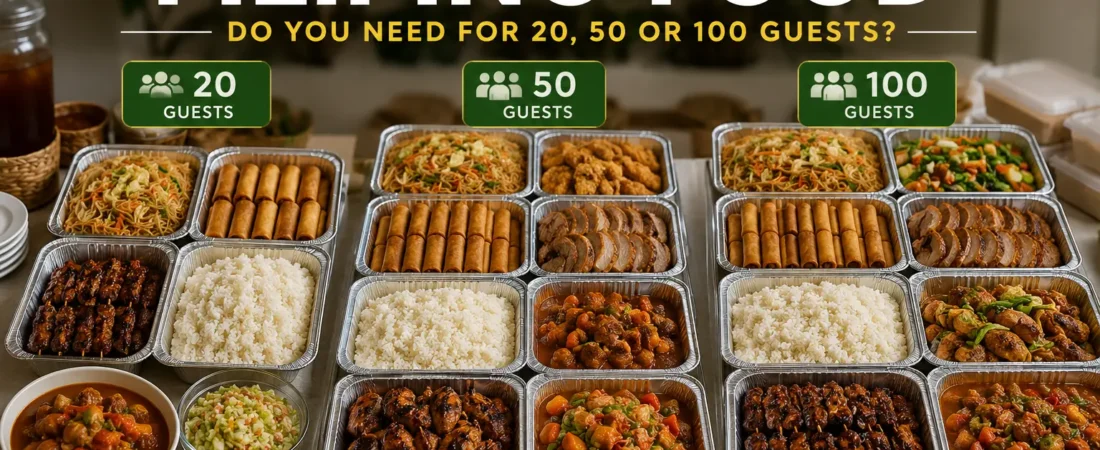
If you are wondering how much Filipino food you need for a buffet, start with total meal portions—not a generic number of trays. For 20 confirmed guests, a practical starting target is about 22 to 23 complete meal portions. For 50 guests, plan about 55 to 58. For 100 guests, plan about 110 to 115.
That modest 10% to 15% buffer can help when guests serve themselves, appetites vary, or the final attendance is not perfectly predictable. It is a planning guide, not a universal catering rule. A responding provider should still translate your guest count and chosen menu into the quantities they recommend.
The most important warning is this: small, medium, large, and full-tray labels are not standardized. A tray’s dimensions, depth, dish, recipe, serving utensil, and role in the meal can all change its estimated yield. Ask for the serving estimate for the specific dish and tray—then confirm whether that estimate assumes it is a side, a main component, or one item in a larger buffet.
If you already know the dishes you want, use the Filipino party-tray planning page to organize your request. If you are still choosing a menu, browse the site’s Filipino food options first.
Last reviewed: September 2, 2026. Serving estimates and tray sizes vary by provider. Confirm quantities, ingredients, allergens, availability, delivery, and service terms directly with the responding independent provider.
Quick portion guide for 20, 50, and 100 guests
The following table assumes Filipino food is the main meal and that a buffet includes a starch, more than one main dish, and at least one side or vegetable dish.
| Confirmed guests | Start with this many complete meal portions | One-bite appetizers before the meal | Dessert portions |
|---|---|---|---|
| 20 guests | 22–23 | 60–80 pieces total | 20–22 |
| 50 guests | 55–58 | 150–200 pieces total | 50–55 |
| 100 guests | 110–115 | 300–400 pieces total | 100–110 |
These are planning targets across the complete menu:
- The meal figure is not the amount to order for each dish.
- The appetizer figure is the total across all appetizer types, not 60 to 80 pieces of every appetizer for 20 guests.
- Dessert can be reduced if a large celebration cake or a separate dessert table will also be served.
- For a long cocktail period, appetizer-only event, or late meal, ask for a higher appetizer target.
- For plated or staff-controlled portions, the provider may recommend a smaller buffer than for open self-service.
What does one “meal portion” mean?
One meal portion means enough food for one guest’s complete plate from the whole menu. It does not mean that the guest receives a full standalone portion of rice, a full standalone portion of pancit, and a full standalone portion of every main dish.
Imagine a buffet with rice, pancit, chicken adobo, beef caldereta, vegetables, and lumpia. Some guests will take rice but little pancit. Others will try a small amount of both mains. Some will skip one dish completely. The food works as a shared menu.
This is why ordering a provider’s “serves 20” quantity of every dish for 20 guests can create far more food than intended. Tell the provider the full menu, the role of the meal, and the total guest count so the quantities can be considered together.
Why there is no universal number of Filipino party trays
Public Ontario menu guides illustrate how much tray language can differ. One provider describes tray sizes using broad guest ranges. Another explains that the same full pancit tray can serve more people as a side than when it acts as a main part of the meal. Those estimates are specific to those providers; they are not an industry standard.
Two trays with the same outside length may also yield different portions. A shallow noodle dish, a dense meat dish, whole pieces of chicken, and individually counted lumpia are not measured in the same way.
Before converting your guest count into trays, ask:
- What are the tray’s exact dimensions and depth?
- How many servings does the provider estimate for this exact dish?
- Does that estimate treat the dish as a side or as a main component?
- How many other mains, starches, and sides will be on the buffet?
- Are the portions intended for adults, children, or a mixed group?
- Is the provider allowing for self-service and seconds?
The reliable calculation is:
target portions assigned to a menu category ÷ provider-estimated servings for that specific tray = trays required, rounded up
In practice, the provider should make this conversion after seeing the complete menu. If 50 guests have three main dishes, do not independently order 55 servings of each main. Ask the provider to distribute approximately 55 to 58 total meal portions across all three mains and the rest of the buffet, with extra attention given to the dish most likely to be popular.
A sample Filipino menu structure for 20 guests
For a group of 20, too many dishes can create small leftovers in every category. A focused menu is usually easier to portion and serve.
A practical menu structure might include:
- one appetizer, such as lumpia;
- rice;
- one noodle dish, such as pancit;
- two contrasting main dishes;
- one vegetable dish or lighter side; and
- one dessert, unless a celebration cake is already planned.
Start with a target of 22 to 23 complete meal portions across that menu. If all 20 guests are confirmed, the meal will be served promptly, and portions are controlled, the responding provider may determine that a smaller buffer is suitable. If the meal is an open buffet for hungry adults and teens, 23 or 24 may be more appropriate.
For a birthday or family celebration, also count anyone who may arrive after the meal begins and decide whether leftovers are intentionally wanted for the next day.
A sample Filipino menu structure for 50 guests
At 50 guests, variety becomes more useful because different dietary preferences and appetites are more likely.
A practical menu structure might include:
- one or two appetizers;
- rice;
- one noodle dish;
- three main dishes with different proteins or flavour profiles;
- one or two vegetable dishes or lighter sides; and
- one or two desserts, depending on whether cake is served.
Start with 55 to 58 complete meal portions. For appetizers before a full meal, 150 to 200 one-bite pieces in total is a useful starting range. If serving two appetizer types, split that total between them based on expected popularity; do not order 150 to 200 of each.
For an office lunch, timing and packaging can matter as much as variety. A corporate catering request should state whether everyone eats at once, in shifts, or in individually packaged groups.
A sample Filipino menu structure for 100 guests
For 100 guests, quantity planning should be tied to the event timeline, service method, and venue access. A large buffet can develop shortages in one popular dish even when the total amount of food is sufficient, so distribution and replenishment matter.
A practical menu structure might include:
- two or three appetizers;
- rice;
- one or two noodle or additional starch dishes;
- three or four main dishes;
- two vegetable dishes or lighter sides; and
- two desserts, adjusted for cake or a separate sweets table.
Start with 110 to 115 complete meal portions and 300 to 400 one-bite appetizer pieces in total if a full meal follows. Ask the provider whether the most popular main should receive more capacity than the others and whether the buffet should be replenished in smaller batches.
For a wedding or debut, include the couple or celebrant, family, vendors, entertainers, photographers, and venue staff when determining who requires a meal. Do not assume the invitation count and the meal count are identical.
How many lumpia do you need per person?
For one-bite lumpia served before a full meal, start with three to four pieces per person in total. That equals approximately:
- 60 to 80 pieces for 20 guests;
- 150 to 200 pieces for 50 guests; or
- 300 to 400 pieces for 100 guests.
Lumpia size varies, so confirm the size and piece count with the provider. Increase the estimate if lumpia is one of only a few foods available for an extended period, if dinner will be late, or if it is expected to be the clear favourite. If several other appetizers are offered, divide the total appetizer allowance across the varieties.
Six factors that should increase or decrease your starting target
1. Adults, teens, and children
Give the provider separate counts for adults, teens, and children—and, if possible, the children’s age range. Teenagers may eat adult portions, while young children may eat much less. A fixed “two children equal one adult” rule can be misleading.
2. The role and timing of the food
A full dinner needs a different quantity from merienda, snacks after a ceremony, a late-night meal, or food that supplements a barbecue. State when food will be available and what guests will have eaten earlier.
3. Buffet, plated, or packaged service
Open self-service gives guests control over their first plate and seconds, so a modest buffer can be useful. Plated meals or individually packaged portions allow tighter control but require an accurate final count.
4. Menu variety
More choices can reduce the amount required for each dish, but it does not eliminate the need for enough total food. It can also create leftovers if every dish is ordered as though it must feed the entire group independently.
5. Other food and dessert
Account for charcuterie, potluck dishes, pizza for children, a snack table, a large cake, or food supplied by the venue. Tell the provider what else will be available instead of silently reducing quantities.
6. Desired leftovers and uncertainty
Some hosts intentionally want leftovers; others have limited refrigerator space. Say which outcome you prefer. Also identify whether the count is confirmed, estimated, or likely to change.
A simple worksheet before asking for trays
Complete these details before requesting a quantity recommendation:
| Planning item | Information to provide |
|---|---|
| Event | Type of gathering and meal purpose |
| Date and serving time | Include when guests will actually eat |
| Location | Venue or neighbourhood, access, stairs, elevator, loading, and parking |
| Guest breakdown | Adults, teens, children and relevant age ranges |
| Service style | Pickup, drop-off, buffet setup, staffed service, plated, or individual meals |
| Menu | Preferred dishes plus foods supplied elsewhere |
| Appetizer period | Length of time and whether a full meal follows |
| Dietary needs | Allergies, intolerances, religious needs, vegetarian or other requests |
| Leftovers | None preferred, modest buffer, or intentionally planned |
| Tray information | Dimensions and provider-estimated servings for every selected dish |
If your next question is budget, read what affects Filipino catering cost in London, Ontario. Keep the two decisions separate: first decide the meal and realistic quantity, then compare what each quote includes.
How to avoid running out—or ordering far too much
- Round provider calculations up, not down. A partial extra tray is rarely practical.
- Give the favourite dish extra attention. Equal tray counts can fail when one main is much more popular.
- Do not count expected no-shows twice. If your confirmed number already excludes declined invitations, do not automatically reduce it again.
- Avoid duplicating starch without considering the rest of the menu. Rice and pancit can both be appropriate, but the total starch plan should reflect how many mains and sides are served.
- Ask when the final count is due. Large events should have a preliminary plan and a later confirmed quantity.
- Confirm what “serves” means. A serving estimate based on a ten-dish buffet is not the same as an estimate for a three-dish family meal.
- Plan storage before intentionally ordering leftovers. Large events can produce more food than home refrigerators can cool safely.
Food-safety planning for a buffet and leftovers
Quantity planning is only useful if the food can be held and stored safely. Health Canada’s buffet and leftover guidance says hot food should be kept at or above 60°C (140°F) and cold food at or below 4°C (40°F). Cooked food left at room temperature for more than two hours should be discarded.
Use a clean serving utensil for each dish and clean platters when replenishing a buffet. Refrigerate leftovers promptly in shallow containers. Health Canada advises using refrigerated leftovers within two to three days or freezing them, and reheating food to at least 74°C (165°F).
Ask the responding provider for dish-specific transport, holding, and reheating instructions. Confirm who supplies chafing equipment, fuel, coolers, serving utensils, and cleanup. For delivery outside the city, check the site’s London and nearby service-area information and confirm travel details directly with the provider.
Request a quantity recommendation for your event
The most useful request includes your date, location, serving time, adult and child counts, service style, preferred dishes, dietary needs, other food being served, and whether you want leftovers. Review the available Filipino catering service types, then submit a detailed quote request.
Important disclosure: London Filipino Catering is a quote-request and lead-matching website operated by MRAYLA Lead Systems. It is not a caterer or commercial kitchen and does not prepare, sell, deliver, staff, or serve food. Information submitted through the site may be shared with an available independent catering provider. Each provider determines its own tray sizes, serving estimates, menu, prices, allergens, availability, delivery, staffing, and service terms. Submitting a request is not an order, reservation, or guarantee of service.
Frequently asked questions
How much Filipino food should I plan per person?
For a full buffet, begin with one complete meal portion per confirmed guest across the entire menu. Consider a 10% to 15% buffer for self-service, uncertain attendance, or variable appetites, then ask the provider to translate that target into quantities for the selected dishes.
How many trays of Filipino food do I need for 20 people?
There is no dependable universal tray number because tray sizes and dish yields vary. Start with 22 to 23 complete meal portions across the menu. A focused structure could include one appetizer, rice, pancit, two mains, one vegetable dish, and dessert. Ask the provider to convert that complete menu into its own tray sizes.
How many trays of Filipino food do I need for 50 guests?
Start with 55 to 58 complete meal portions. A practical menu may have one or two appetizers, rice, one noodle dish, three mains, one or two vegetables, and dessert. The actual tray count must use the selected provider’s dimensions and serving estimate for each dish.
How much Filipino food should I order for 100 people?
For a full buffet, start with 110 to 115 complete meal portions. Consider two or three appetizers, rice, one or two noodle or starch choices, three or four mains, two vegetables, and dessert. Ask the provider to allocate capacity across the menu and add more of the likely favourite dish.
How many lumpia should I order per guest?
When a full meal follows, three to four one-bite pieces per person is a useful starting point. That number is the total lumpia allowance, and size varies. Increase it if lumpia will be available for a long period, dinner is late, or it is expected to be especially popular.
Does every guest need one serving of every dish?
No. A meal portion is distributed across the complete buffet. Guests take different combinations and smaller amounts of multiple dishes. Ordering the full guest count for every dish can create unnecessary excess.
Should I order extra food for a buffet?
A 10% to 15% buffer is a practical starting point for many self-service meals, but it is not always required. A provider may suggest a different amount based on the menu, guest mix, service method, event duration, and whether leftovers are wanted.
How should I count children when ordering food?
Give the provider the number and age range of children instead of using a fixed half-portion rule. Older children and teens may eat adult quantities, while young children may eat much less.
Does submitting a quote request reserve catering?
No. A submission is a request for information, not an order, reservation, or guarantee. Menu, quantities, pricing, availability, allergens, delivery, and all service terms must be confirmed directly with the responding independent provider.