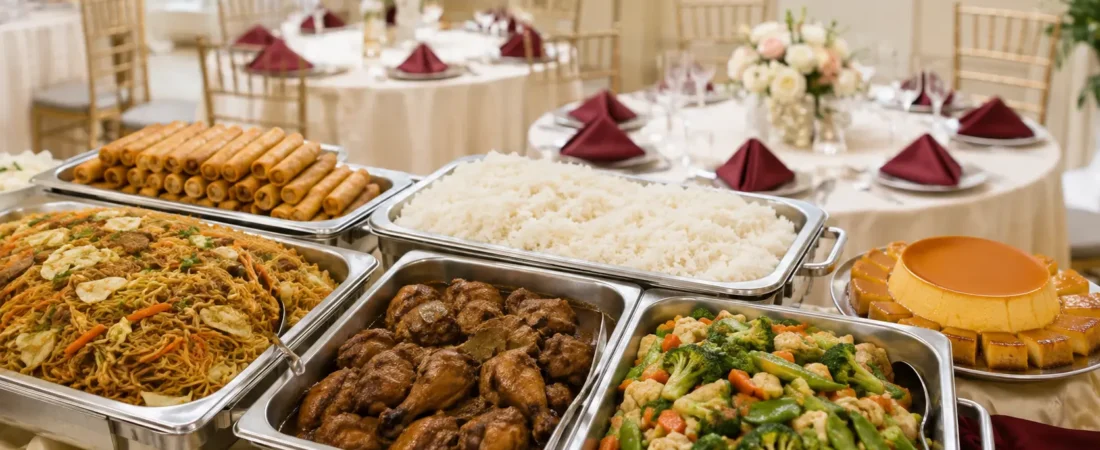
Use this Filipino wedding and debut menu planning checklist to connect your food choices with the details that make the reception work: the venue, guest count, dietary needs, service arrangements and programme.
Start with those decisions before settling on a long list of dishes. A menu can look complete on paper and still leave unanswered questions about who serves dinner, when dessert comes out or what happens while the family is taking photographs.
For a celebration in London, Ontario, the goal is one clear plan that the family, venue and selected catering provider can all follow.
London Filipino Catering is a quote-request and referral website. Independent catering providers must confirm menus, ingredients, prices, availability and service arrangements.
Your Filipino wedding and debut menu checklist at a glance
Before confirming the catering, work through these ten decisions:
- Record the event details, budget and decision-maker.
- Confirm the venue’s catering rules and facilities.
- Choose the menu around the couple or celebrant.
- Review dietary requirements and serving assistance.
- Assign setup, meal service and cleanup duties.
- Fit dinner and dessert into the programme.
- Confirm quantities and the final guest-count deadline.
- Review the menu details and complete quote.
- Share one final catering brief with the event team.
- Check the handover on the day of the celebration.
You can begin exploring Filipino wedding and debut catering options while some details are still provisional. Tell the provider what is confirmed and what may change.
1. Record the event details and food priorities
Start a single planning note with the event type, preferred date, venue or city, approximate guest count, intended meal time and catering budget.
For a wedding, ask the couple which dishes matter most to them. For a debut, include the celebrant in that decision alongside the people organizing the reception. Family favourites can guide the menu, but the person being celebrated should have a voice too.
Choose a short list of must-have dishes and a separate list of flexible choices. This helps the provider suggest substitutions without changing the part of the meal that matters most to the family.
Name one person to approve menu changes and communicate the final decisions. Several relatives sending different instructions can leave the provider unsure which version to follow.
Begin enquiries as soon as you have a likely date and guest range. Booking windows, minimums and availability vary; do not treat another person’s lead time as a guarantee for your event.
2. Check the venue before finalizing the menu
Ask whether the venue allows outside caterers, requires an approved provider, or includes any food service in its own package. Confirm what is available for your actual booking.
Kitchen access needs a specific conversation. For example, the City of London’s information for Civic Garden Complex describes facilities for light preparation and serving, not cooking. The practical implication is to confirm how dishes will arrive and be held or finished before selecting the menu.
Check these details with the venue and provider:
- Delivery entrance, parking and unloading access.
- Earliest setup time and the deadline for clearing the room.
- Kitchen, refrigeration and permitted food-holding equipment.
- Buffet tables, power access and usable serving space.
- Who supplies plates, cutlery, glasses and linens.
- Rules for outside cakes, desserts or family-supplied food.
If you are considering lechon, soup, a live cooking station or another item needing special handling, ask how it will be served in that particular space. A venue name alone does not confirm the facilities your menu needs.
3. Build the menu around the celebration
A useful starting structure is an optional appetizer, rice, a noodle dish, two contrasting mains, vegetables and dessert. It is a planning framework, not a required package.
For example, you might discuss lumpia before dinner, followed by rice, pancit, chicken inasal, beef caldereta and vegetables. Another family might prefer chicken adobo and pork barbecue as the mains. Actual choices depend on the provider and your guests.
Use the Filipino food options page to create a shortlist. Avoid adding dishes simply because they appear on a menu: each addition should offer a wanted flavour, another suitable choice or a meaningful family favourite.
| Planning decision | Wedding reception | Debut celebration |
|---|---|---|
| Menu priorities | Agree on the couple’s must-have dishes and family requests | Include the celebrant’s preferences and family requests |
| Meal timing | Coordinate with the ceremony, photographs and reception entrance | Coordinate with the entrance, performances and family presentations |
| Guests away from their tables | Plan when the couple and wedding party can eat | Plan when the celebrant and programme participants can eat |
| Cake and dessert | Confirm the cake supplier, cutting and dessert service | Confirm the cake presentation and any other desserts |
| Changes during the event | Give the coordinator one authorized family contact | Give the coordinator one authorized family contact |
If a separate celebration cake is planned, count it in the dessert discussion. You may want cake plus leche flan or another Filipino sweet, but you do not automatically need several additional desserts.
For help choosing combinations, see our guide to the best Filipino dishes for a party buffet.
4. Confirm dietary needs and serving assistance
Collect dietary requirements before agreeing on the final menu. Give the provider specific information rather than a general note that some guests need special food.
Ask for confirmation of each relevant dish, including sauces, stock, marinades, garnishes and preparation arrangements. A vegetable dish is not automatically vegetarian, and a dish made with rice noodles is not automatically suitable for someone avoiding gluten.
Ask whether a guest needs a complete alternative meal and how it will reach the correct person. Separate serving utensils and clear identification can support the plan, but they do not establish that a kitchen can meet every requirement.
Health Canada explains that allergens can transfer through shared equipment, utensils and food preparation. Discuss the provider’s capabilities and limitations directly with the guest concerned before confirming an arrangement. Health Canada’s allergen guidance
Also ask whether anyone needs help reaching the buffet or carrying a plate. Decide who can assist and whether the table layout leaves a comfortable route. Keep detailed dietary information with the people who need it to prepare and serve the meal.
5. Assign the food-service jobs
Choose a service arrangement after deciding how much support the event needs. A tray order, delivery with setup and staffed catering leave different tasks for the hosts.
Write down who handles each responsibility:
| Task | What to confirm |
|---|---|
| Receiving the order | Contact person, arrival time and order check |
| Setting up | Tables, food arrangement, equipment and dish identification |
| Serving the meal | Buffet supervision, replenishment and assistance to guests |
| Serving the couple or celebrant | Agreed timing and a suitable serving arrangement |
| Cake and dessert | Cutting, plates, utensils, presentation and distribution |
| Clearing and packing | Used dishes, leftovers, rubbish and equipment returns |
Do not assume that “full service” includes every job. Remely’s published catering information illustrates how a provider can specify a service period, equipment and particular clearing duties. It is an Ontario example, not a London package or a promise of local availability.
If you choose Filipino party trays, make sure the assigned helpers are actually free during the meal. Someone taking part in the programme may not be available to manage food at the same time.
Compare party trays and full-service Filipino catering when deciding how much help to request.
6. Fit dinner and dessert into the programme
Share the reception programme with the provider before it is finalized. The schedule should make clear when guests arrive, when food service starts and when the main presentations happen.
For a wedding, consider the gap between the ceremony and dinner, including travel and photographs. If guests will wait at the reception, discuss whether refreshments or appetizers are needed.
For a debut, list the performances and family presentations the celebrant has chosen. If the programme includes an 18 roses or 18 candles segment, allow for it explicitly rather than treating it as a short, unscheduled pause.
There is no single compulsory order for the meal and programme. The important point is to agree on it with everyone responsible for service.
Example reception sequence
This is an illustrative sequence. The provider and coordinator must set the actual times and meal duration for the guest count and venue.
| Programme point | Food-service decision |
|---|---|
| Guest arrival | Decide whether drinks or appetizers are offered and by whom |
| Welcome and entrance | Confirm when staff receive the cue to begin dinner |
| Main meal | Allow an agreed period for serving and eating |
| Speeches, dances or presentations | Confirm whether food service continues or the buffet closes |
| Cake presentation | Agree when cake cutting and dessert service begin |
| Later celebration | Decide whether any additional food is wanted |
| End of event | Confirm packing, equipment collection and venue-clearance duties |
Ask what happens if photographs or a presentation runs late. Identify who can authorize a change and whether extending service would incur another charge. Keep the couple or celebrant informed without making them manage every food-service decision.
7. Confirm quantities and the guest-count deadline
Tell the provider how many people need each part of the meal. Include children, any agreed vendor meals, and guests attending only part of the reception.
Ask for the deadline to confirm numbers and how later changes are handled. If a quote uses a minimum guest count or a guaranteed number, ask what that means for the final bill and food quantities.
Plan portions across the entire menu. Do not assume each guest needs a full standalone serving of rice, noodles and every main. Ask the provider for the servings of the specific dishes and trays being quoted.
For family-style platters or a buffet, explain how you want food distributed. Discuss replenishment and whether a separate meal needs to be arranged for someone temporarily away from the room.
If you want leftovers, say so during planning. Agree on the amount to order and the handling arrangements rather than treating excess food as an automatic part of the booking.
Our guide to how much Filipino food you need for 20, 50, 100 guests explains the quantity-planning starting points.
8. Review the complete quote and menu details
Compare quotes using the same guest count, dishes and service expectations. A food-only tray total and a staffed reception package cover different things.
Confirm the menu’s specific details: meat choices, serving format, bone-in or boneless pieces where relevant, sauces, requested substitutions and dessert portions. Ask whether a tasting is available, what it costs, and whether it represents the dishes and service format proposed for your event.
Your written quote should make it possible to identify:
- Food and agreed quantities or guest numbers.
- Delivery, travel and setup charges.
- Equipment, rentals and tableware.
- Staff roles, booked hours and extension terms.
- Cake-cutting or dessert-service charges, if any.
- Applicable taxes, service charges and gratuity arrangements.
- Deposit, payment dates, change deadlines and cancellation terms.
Ask about anything unclear before paying. This is a checklist of questions to resolve with the provider, not a statement that every business uses the same fees or booking terms.
See our Filipino catering pricing guide for more on comparing the components of a quote.
9. Send one final catering brief
Once the details are agreed, put them in one dated document or message. Send the relevant information to the provider, venue contact and coordinator so they are working from the same plan.
Record who approved the final version. If something changes afterward, update that version and confirm that the affected people received it.
Final menu confirmation record
| Item | Information to record |
|---|---|
| Event | Wedding or debut, date and complete venue address |
| Contacts | Provider, venue contact and authorized event contact |
| Guest numbers | Final meal count, agreed vendor meals and special meals |
| Menu | Exact dishes, substitutions, quantities and dessert plan |
| Dietary arrangements | Provider-confirmed meals and how they will be identified |
| Schedule | Arrival, setup, dinner cue, service end and dessert cue |
| Equipment | What each party supplies and who returns rentals |
| Responsibilities | Service, cake cutting, clearing and packing |
| Money and changes | Agreed total, remaining payment and change terms |
| Event finish | Equipment collection and venue-clearance deadline |
Ask separately about family-supplied food or a cake arriving from another supplier. Confirm who receives it, where it is stored and who is responsible for serving it.
10. Check the handover on the day
Have the authorized contact meet the provider, check the dishes against the agreed menu and confirm any separately arranged meals. Verify the dinner and dessert cues with the coordinator.
Agree on who will manage food temperatures and replenishment. Health Canada recommends keeping hot food at or above 60°C and cold food at or below 4°C, and discarding perishable food left at room temperature for more than two hours. Replenish with clean serving dishes instead of topping up dishes already in use. Health Canada’s buffet guidance
Arrange serving time for the couple or celebrant through the provider. Avoid putting a plate aside at room temperature for an extended photo session or programme segment.
At the end, follow the agreed leftover instructions and confirm equipment collection. These small handovers help the family participate in the celebration while the assigned people manage the meal.
Request Filipino wedding or debut catering options
A clear brief gives an independent provider useful information to review: your event date, venue, guest count, preferred dishes, service needs and budget.
If the venue is outside London, check the catering service-area information and include the full address. Travel boundaries and available arrangements vary by provider.
Request a Filipino catering quote when you are ready to explore options. Submitting the request does not place an order or confirm availability. Your selected provider must confirm the menu, price, service and booking arrangements directly with you.
Frequently asked questions
What should a Filipino wedding or debut menu include?
Start with the couple’s or celebrant’s preferences, then discuss rice, noodles, contrasting mains, vegetables and dessert. Appetizers and other additions depend on the schedule and guests. No single dish or number of courses is required.
Do I need a confirmed venue before requesting catering information?
You can start an enquiry with the city, likely date and estimated guest count. Mark the venue as provisional. The complete address, facilities and access arrangements are needed before final service details can be confirmed.
Should dinner come before or after the debut programme?
There is no single required order. Agree on the sequence with the celebrant, family, coordinator and provider. Account for the length of presentations, when guests will eat and how food service will be managed.
Can party trays work for a wedding or debut?
They can be considered if the venue permits the arrangement and you have a complete plan for quantities, equipment, serving and cleanup. Confirm the provider’s capacity and what the tray order actually includes.
Do I need lechon on the menu?
No. Include it if it is wanted, available and practical for the venue and budget. Other requested mains can form a complete menu. If choosing lechon, confirm preparation, carving, serving and equipment needs.
When should I finalize guest numbers?
Use the deadline agreed with the provider. Ask how the final count affects portions and price, and whether additions or reductions are possible afterward. Include everyone who has an agreed meal, including vendors where applicable.
Does the catering package automatically include cake cutting and cleanup?
No. Those tasks must be confirmed in the written scope. Ask separately about cake cutting, plates, serving, clearing, rubbish, leftover containers and rental returns.
Does London Filipino Catering prepare or serve the food?
No. London Filipino Catering is a quote-request and referral website. Food preparation and service arrangements are confirmed with the selected independent catering provider.