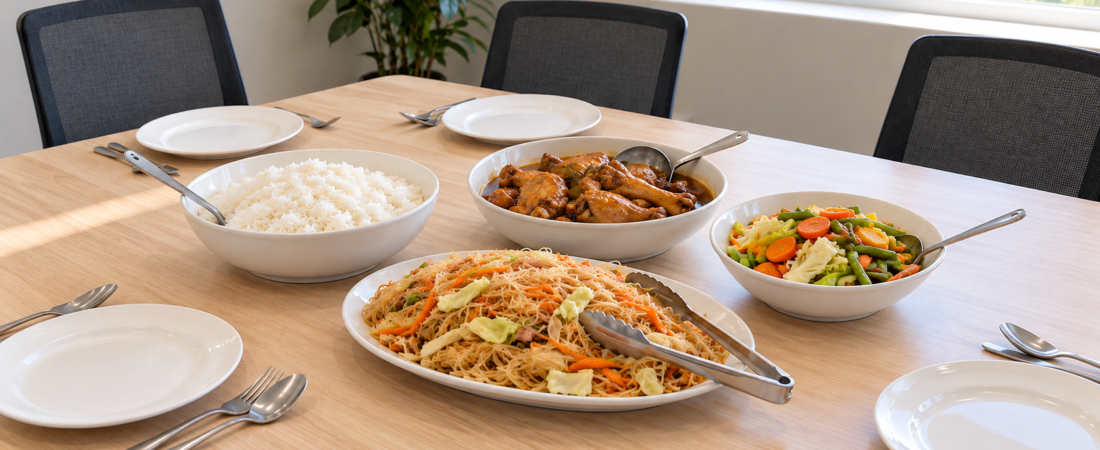
A Filipino office lunch catering plan should give the provider more than a guest count. Include the meal date, the actual eating window, building access, service format and dietary requirements. Then assign someone at work to receive the order and manage the agreed setup.
That approach helps when a lunch must fit around meetings, training or staggered breaks. The food can be well chosen and still create difficulties if it arrives at the wrong entrance or nobody knows where it should go.
The corporate catering page provides an enquiry route for workplace meals in London, Ontario. London Filipino Catering is an independent quote-request website. A responding provider must confirm its menu, availability, delivery arrangements, equipment, staffing and booking terms.
Define the purpose and the eating window
Start with what the lunch needs to accomplish. A team appreciation meal, a working meeting and a training day have different schedules, even if all three involve the same number of people.
Write down when people can actually eat. If a meeting ends at noon but staff need to move rooms, the serving time may be later. If colleagues take breaks in separate groups, tell the provider about those groups rather than treating lunch as one continuous buffet.
Useful questions for the organizer include:
- Is lunch the main meal, or are people also receiving other food?
- Will everyone eat together or in separate groups?
- Where will people collect food and sit?
- How much time is available for eating and cleanup?
- Who can receive a delivery before the meal starts?
- What happens if the meeting or training session runs late?
Choose an agreed arrival window that allows the necessary handover and setup without creating an unsupported holding period. Ask the provider how its proposed service format fits the schedule.
Build a usable attendance count
Use one count that the organizer can update. Confirm who is working on site, who has accepted the lunch invitation and whether visiting trainers or other invited attendees need meals. Do not rely on a company-wide employee total for a lunch that only some people will attend.
Give the provider a current number and explain any uncertainty. Ask when quantities become final and how additions or reductions are handled. That deadline comes from the provider’s terms, not a universal office-catering rule.
If people eat in separate groups, record the count for each group. A provider may suggest a different arrangement for two distinct meal windows than for one shared lunch.
The existing Filipino food portion guide explains why quantities should cover the whole menu. Let the responding provider translate the actual attendance and menu into its portions or tray sizes.
Match the service format to the workplace
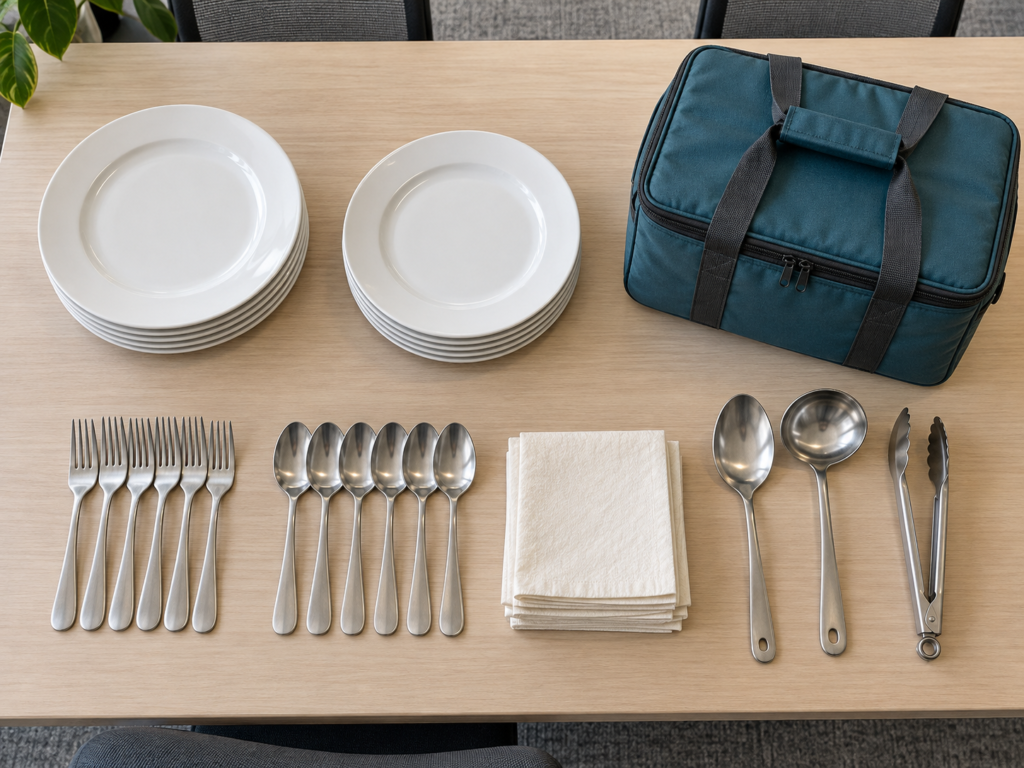
Ask what the provider offers and which responsibilities remain with your team. Party trays, a drop-off arrangement, staffed service or individually packaged meals may be options with some providers; none is automatically available or included.
| Workplace situation | Arrangement to ask about | Detail to settle |
| Everyone eats in one room | Shared trays or a buffet arrangement | Table space, serving equipment and who manages the food |
| Staff eat in separate groups | A format suited to the agreed meal windows | Quantities and safe holding or separate handovers |
| A meeting has a short lunch break | A practical collection and serving arrangement | How guests reach the food without delaying the session |
| A room has limited equipment | A service plan compatible with the room | What the provider supplies and what the workplace needs |
| Certain guests need a separately agreed meal | A provider-confirmed arrangement | Identification and handling without an allergy guarantee |
Read the party trays versus full-service Filipino catering guide before comparing offers. Two quotes are easier to assess when they cover the same duties.
Do not let “delivery included” stand in for a complete service description. It may describe bringing food to a receiving point, without arranging tables, placing every tray or cleaning up afterward. Confirm the scope in writing.
Choose food that fits the occasion
A workplace lunch does not need the largest possible selection. Build the menu around the meal’s role, the people attending and the provider’s available dishes.
Use the Filipino food-options page for ideas, then request the actual menu. Ask about dishes that are practical to serve in the chosen space and the utensils guests will need. If the room has no suitable preparation facilities, mention that before agreeing to food that needs additional work.
The balanced party-buffet menu guide can help with dish roles. Keep the office discussion focused on what will work during this lunch rather than adding choices simply to make the menu longer.
Collect dietary requirements through your workplace’s appropriate process. Share only the details needed to arrange the meals, and ask the affected guest what they need confirmed. Vegetarian preferences, religious requirements and food allergies require different conversations; one checkbox does not resolve all three.
For allergies, Food Allergy Canada’s dining-out guidance supports asking directly about ingredients and preparation. Confirm the specific arrangements with the provider. A separately packed or labelled meal does not by itself establish protection from cross-contact.
Explain the delivery route before the day
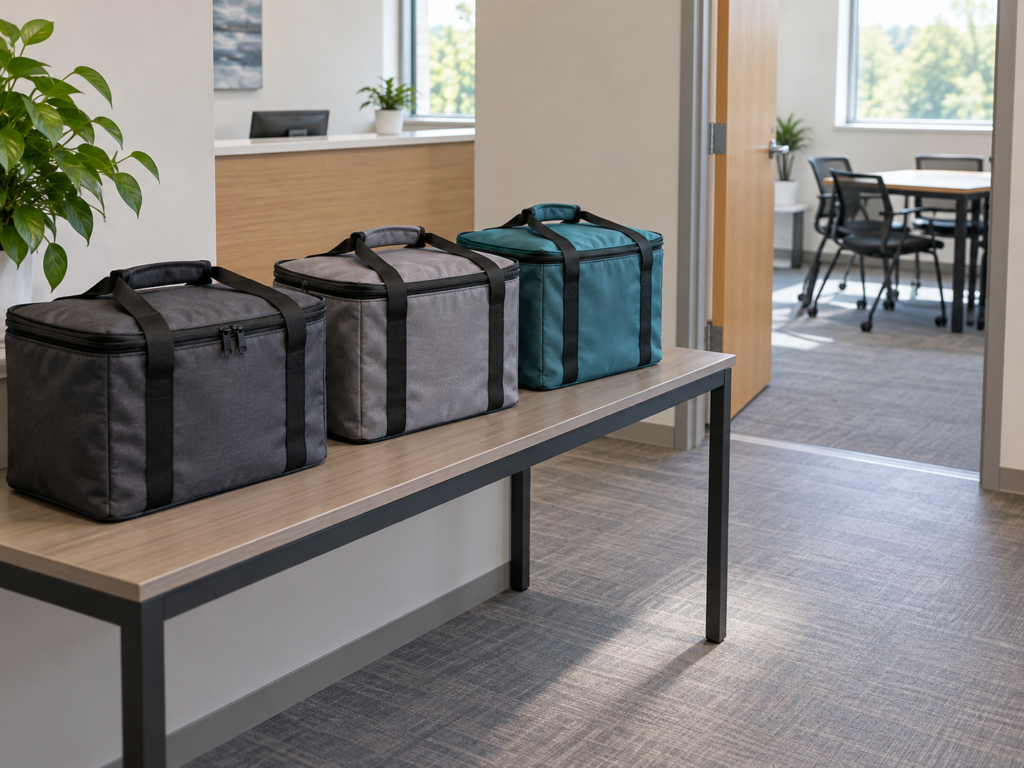
An office address can have several entrances, a loading area and controlled access. Send the provider the location it has agreed to use, along with a contact who can be reached during the arrival window.
Include practical details that affect the handover:
- Reception or security procedures and any visitor requirements.
- The agreed entrance, parking or unloading arrangements.
- Floor, lift access and the room where the food is needed.
- Who meets the provider and helps with any workplace access.
- Whether the order must be carried beyond the receiving point.
- Where agreed equipment will be placed and later collected.
Check the route with the building contact before promising access. A staff member’s usual parking space may not be available to a delivery vehicle, and a loading bay may require a separate arrangement.
Keep an alternate workplace contact available in case the main organizer is leading a meeting. Share that contact with the provider through the agreed communication method; do not leave the driver to find someone in a directory.
Plan the room and the handover
Confirm tables, plates, cutlery, napkins, serving utensils and rubbish collection. Identify who supplies each item. If heating, cooling or other equipment is needed, verify that it is suitable and allowed in the space.
Food should not remain unattended while staff are in a long session. The Public Health Agency of Canada’s food-safety guidance recommends cold holding at 4°C or below and hot holding at 60°C or above. Discuss a suitable plan with the provider for the actual meal windows.
At receipt, compare the order with the confirmation and obtain any agreed handling instructions. If something is missing or the arrangement differs from what was agreed, contact the provider promptly. Do not improvise a prolonged room-temperature buffet to compensate for a schedule change.
Use a short responsibility sheet
Consider an illustrative training lunch for 28 confirmed attendees. Lunch is planned for 12:15 p.m., the room is on the second floor, and visitors must enter through reception. A shared meal may work, but the organizer still needs a receiving contact, an agreed arrival window and a clear equipment list.
The following sheet makes those duties visible. Replace the example with your own names and provider-confirmed arrangements.
| Task | Workplace owner | Confirmation needed |
| Attendance and dietary details | Lunch organizer | Final count deadline and accepted requirements |
| Building access | Reception or facilities contact | Entrance, visitor process and unloading arrangement |
| Order receipt | Named receiving colleague | Arrival window, order list and provider contact |
| Room setup and serving | Agreed workplace contact or provider | Exact division of equipment and duties |
| End of lunch | Assigned workplace contact | Food handling, cleanup and equipment collection |
This example is a coordination tool, not a package offered by the website. A useful plan names a person for each duty instead of assigning everything to “the team.”
Confirm the quote and approval process
Ask for the complete price for the agreed menu and service scope. Clarify applicable taxes, delivery charges, equipment or staffing costs, minimums and any other quoted inclusions. Use the Filipino catering cost guide for the broader questions to ask.
Tell the provider about workplace purchasing requirements before the order is finalized. An internal approval, purchase-order reference or invoice requirement can affect how your organization books the meal. Do not assume that receiving a quote completes your employer’s process.
For repeat lunches, ask separately about recurring availability, menu changes, ordering deadlines and how each date is confirmed. A successful one-time enquiry does not establish a standing delivery arrangement.
Start with the corporate catering enquiry form. Include the date, serving time, address, current attendance, requested format, dietary requirements and useful access details. Confirm the final arrangement directly with the selected provider.
Frequently asked questions
1. What should an office lunch catering enquiry include?
Include the date, meal time, workplace address, attendee count, service preference, dietary requirements and receiving contact. Add building-access details that affect delivery or setup.
2. How far ahead should we request a workplace lunch?
Enquire once the main details are known. Availability and booking deadlines depend on the provider, date and order size. Do not assume a short-notice or holiday booking will be accepted.
3. Can we request individually packaged meals?
You can ask, but availability depends on the provider. Confirm the menu, packaging, quantities, identification and any dietary arrangements before treating that format as agreed.
4. What if employees take lunch in separate groups?
Give the provider the count and eating window for each group. Discuss whether the proposed format can support those windows safely and practically, including holding or separate handovers.
5. Does office delivery include buffet setup?
Only if the provider explicitly includes it. Confirm the receiving point, table setup, serving equipment, staffing and cleanup duties rather than relying on the word “delivery.”
6. How do we account for remote or visiting colleagues?
Count people actually expected to eat at this event. Ask invitees to confirm attendance and include visitors who need meals. Tell the provider when the count remains provisional.
7. Can dietary meals simply go on a separate table?
Placement alone does not confirm suitability. Discuss the actual ingredients, preparation, identification and cross-contact concerns with the provider and the affected guest.
8. What if the meeting runs late?
Use the delay plan agreed with the provider and receiving contact. Food still needs suitable temperature control; do not leave it unattended at room temperature while the meeting continues.
9. Can the website arrange a recurring office lunch?
You may describe that requirement in an enquiry. A provider must confirm whether recurring service is available and agree the menu, dates, ordering process and payment terms directly.
10. Does submitting the corporate form confirm an order?
No. It submits a quote request that may be shared with independent providers. Booking requires the selected provider’s confirmation of availability, scope, price and terms.